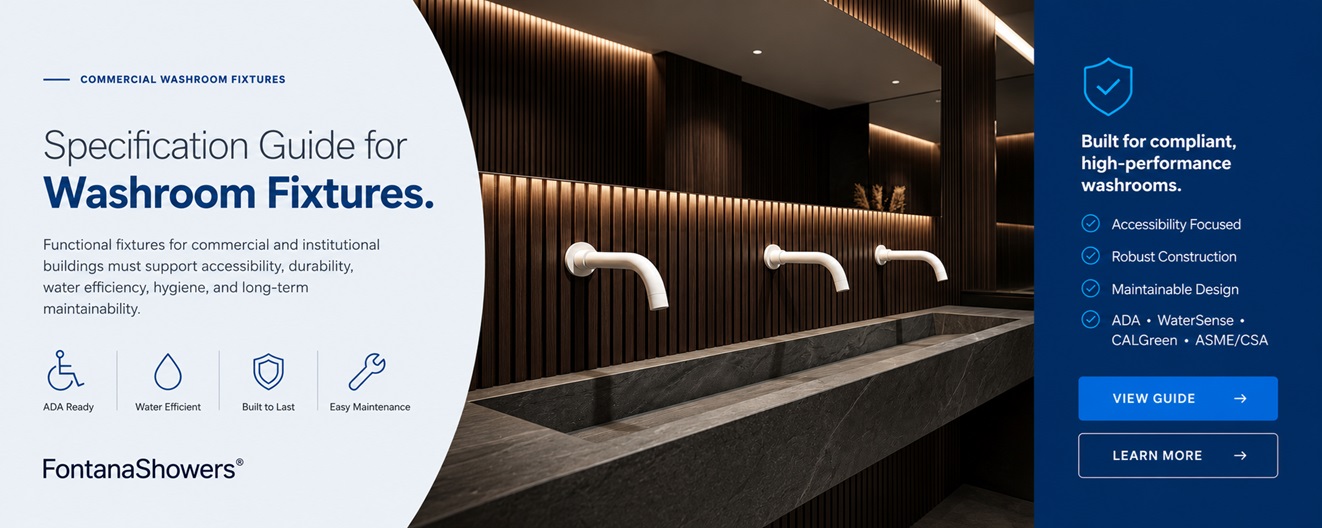
Bathroom Fixtures for High-Use Commercial and Institutional Restrooms
In commercial and institutional buildings, washroom fixtures are functional components, rather than accessories. Toilets, sinks, urinals, showers, and their valves are supposed to comply with multiple parameters, including structural support, functionality, ease of access, robustness, and maintainability. This guide contains specifications that help in complying with
ADA,
WaterSense,
CALGreen,
and
ASME/CSA plumbing specifications.
ADA AccessibilityWaterSense & CALGreenASME / CSA PerformanceHigh-Use Durability
Bathroom fixtures in educational institutions, airport terminals, healthcare, hospitality, and government institutions require careful consideration and specification as engineered systems. For spec-ready examples of coordinated fixtures and documentation, see
Fontana commercial washroom fixtures.
Design and Technical Visuals
Main Specification Features
Read MoreRead Less
ADA Accessibility & Clearances
Fixture locations, seat heights, operable controls, and shower components must comply with ADA dimensional requirements, such as 60 inches of side clearance, 56 inches of rear clearance for water closets, and 17-19 inches of seat height, which were determined as early as the planning stages. See
ADA Chapter 6 for dimensional criteria.
Water Efficiency Targets
Moreover, WaterSense and CalGreen requirements set flush and flow rates, for instance, 1.28 gpf toilets, 1.5 gpm lav faucets, and < 2.0 gpm showerheads. Refer to
EPA WaterSense and CALGreen code resources for current performance thresholds.
ASME – CSA Performance Standards
ASME A112 and CSA B45 series describe load resistance, trap seal depth, glaze quality, and drainage performance for ceramics, stainless steel, and composites that are the core of plumbing specifications in Division 22. A current index is available at
ASME A112 / CSA B45.
Durability and Materials
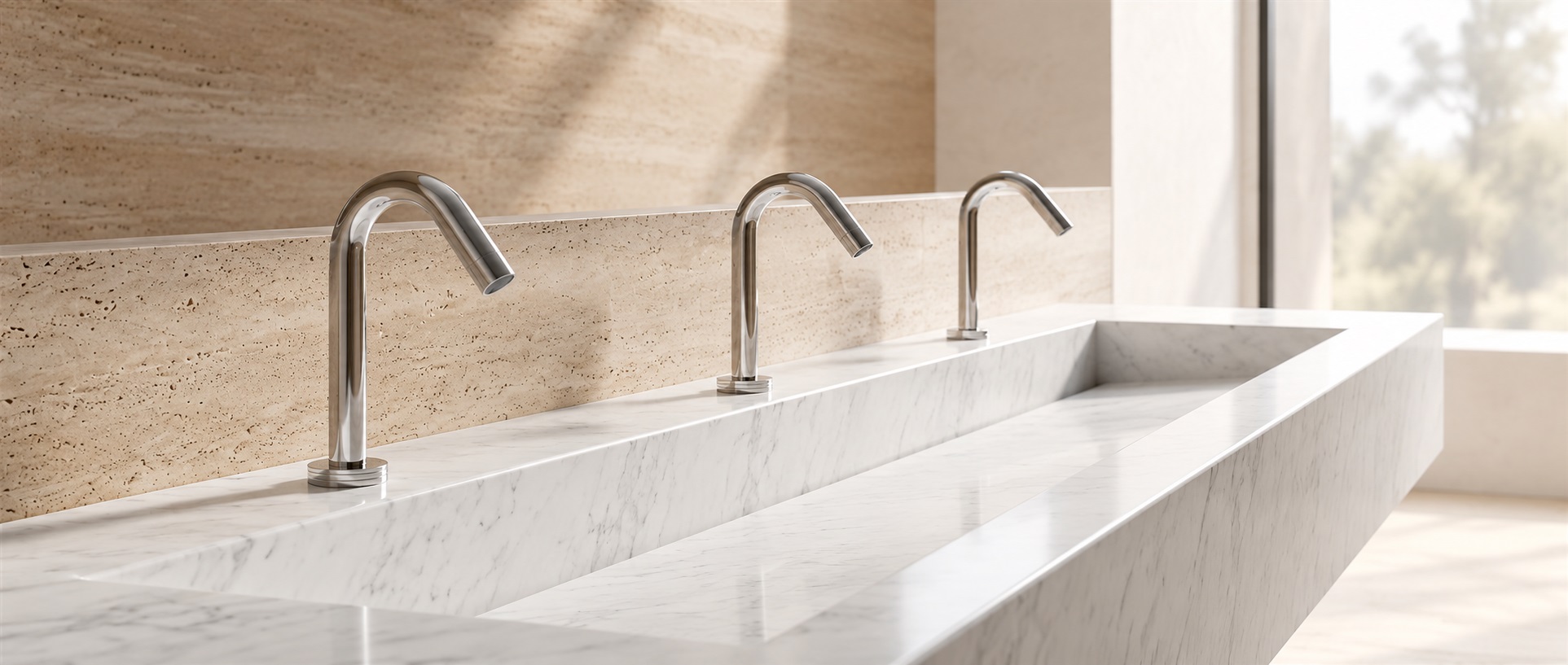
These types of vitreous china, stainless steel, and solid surface/composite fixtures are expected to resist heavy usage, vandalism, and repeated cleaning with commercial chemicals. For examples of vandal-resistant sensor fixtures, see
Fontana restroom touchless faucets.
Structural & Mounting Integrity
Where wall-hung fixtures are involved, heavy duty carriers are needed for static/dynamic loads, as well as sufficient wall support.
Serviceability & Lifecycle
Accessible valve boxes, removable access panels, standardized cartridges, and proper sensor and transformer access all make it easier to maintain, particularly when paired with vendors that provide installation details and spec sheets such as
Fontana washroom fixtures.
Fixture Materials, Structure, and Hydraulics
Read MoreRead Less
Material Selection for Use
Vitreous China: This adds strength, hardness, and durability to toilets, urinals, and sinks.
Non-porous surfaces, accessible fixtures, and infection control practices that are amenable to cleaning are all important for infection control.
Hospitality
While design finishes require a supportive substrate and clearance, as a balance of experience and functionality, other design considerations are also important.
Retail + Mixed-Use
Heavy pedestrian traffic demands vandal-proof hardware, sensor-operated controls, and easy cleaning; in other words, fixtures are infrastructure, not ornament. See
commercial sensor faucets for retail and mixed-use facilities.
Education & Civic
Long life, standard components, and heavy-duty mounting make it expensive for campuses of multiple buildings and other public structures. For education-focused touchless solutions, refer to
touchless faucets for educational institutions.
Corporate Campuses
It would require consistent mounting heights, flow rates, as well as sensor logic, which would make sustainability and greater accessability easier. See
touchless faucets for commercial buildings for portfolio-wide strategies.
Technical Specification Framework
Read MoreRead Less
Fixture Scope
Toilets, urinals, lavatories, showers, and related valves, in commercial and institutional restrooms, as specifier-driven systems rather than for ornamentation. For coordinated product families, see
Fontana washroom fixtures overview.
Accessibility (ADA)
Satisfies requirements for clearances, reach ranges, and usability— including side clearance of 60 in, 56 in of rear clearance, 17-19 in of seat height, height of lavatory of < 34 in, and proper location of flush/shower control. Refer to
ADA Chapter 6 for official diagrams.
Water Efficiency
Meet WaterSense and CALGreen requirements for efficiency, such as 1.28 gpf for toilets, 1.5 gpm for lav faucets, and 2.0 gpm for showerheads, without compromising product performance, as outlined by
EPA WaterSense and CALGreen.
Performance Standards
Use ASME A112.19.2/CSA B45.1 for ceramic, ASME A112.19.3/CSA B45.4 for stainless steel, and ASME A112.18.1/CSA. See
ASME A112 index for current standards.
Listings & Certification
Require third-party listings, such as IAPMO cUPC, and proof of ASME/CSA compliance, WaterSense labeling where necessary, and CALGreen compliance. Many commercial fixtures cataloged at
Fontana washroom fixtures provide these listings in downloadable form.
Mounting & Structure
Specify carriers, support, weight capacity, and access panels for valves/sensors.
Integration & Documentation
Include
BIM/Revit Families for clash detection, rough-in dimensions, mounting heights, and corresponding flow control, mixing valve, and backflow prevention assemblies for Division 22 specifications.
Important Governing Frameworks
ADA AccessibilityWaterSenseCALGreenASME / CSA / cUPC
Integration & Coordination
Fixtures should be coordinated with sensors, transformers, and access panels.
BIM/CAD, rough-in templates, and submittal sub of Division 22.
Make it easy for the customer with instructions on carriers, support, and ADA layout compliance.
Specification Strategy for Architects and Engineers
Read MoreRead Less
Reference Governing Standards
Must anchor to ADA accessibility specifications, performance requirements of ASME A112 and CSA B45, WaterSense labeling requirements, CALGreen water savings specifications, and local building codes (see also
touchless faucets and soap dispensers for public restrooms as a spec-ready reference).
Define Performance Requirements
Enumerate target flow/flush volumes, pressures, ADA height requirements, and vandal resistance expectations for every type of fixture.
Materials & Structural Requirements
Define fixture materials, carriers, backings, loading capabilities, and reinforcement needed such that walls, partitions, and slabs are defined with sufficient detail for use over a prolonged period of time.
System Integration
Include document sensor power (battery or low-voltage), mixing valves, backflow preventers, and access panels in order to facilitate installing control systems without requiring invasive plumbing.
Compliance & Documentation
Mandatory certification for ASME/CSA, cUPC, and WaterSense when appropriate.
Lifecycle & Maintainability
Design for components to be user-replaceable, for standardized cartridges, and for easy access points for high volume usage over several decades.
Documentation & Coordination Checklist
Read MoreRead Less
Recommended inclusions
ADA diagrams: clearance, height, and reach range specifications for toilets, lavatories, and showers.
Cut sheets and performance data for all fixtures and valves.
Certification for compliance with ASME/CSA, and IAPMO.
A request for compatibility information, vandal-resistance options, and access requirements related to healthcare, transit hubs, and other critical facilities for use in healthcare-based fixture purchases would look like this: Technical Information Sheet for Commercial and Institutional Bathroom Fixtures. Requirements, specifications, and performance are subject to change—current editions should be referenced for project use. For current product data, refer to resources such as
Fontana washroom fixture documentation.
Customer Field Review
Fontana Geneva Chrome Commercial Sensor Faucet Field Review
A specification-focused evaluation of same-series Geneva customer and facility records covering
sensor stability, reflective-surface behavior, shutoff timing, inlet-pressure variation,
commissioning, service access, maintenance demand, and long-term commercial use.
✔ Same-Series FS1226 Records Referenced✔ Multi-Year Field History✔ Commercial Facility Context2021–2026 Review Records
Same-Series Field ReviewCommercial Sensor FaucetModel FS1226CH
Finley Whitmore, Infrastructure Advisor — Spokane, Washington
Transportation and Municipal Retrofit Evaluation
Review record date: March 30, 2026 • Rating: 5 out of 5
Customer Review
The workbook contains no exact FS1226CH-coded entry, so the primary field evidence comes from
the same Geneva FS1226 platform. The strongest record compares this faucet family with older
touchless fixtures used in transportation and municipal restroom retrofits from 2022 through 2025.
Read More
Finley Whitmore reports fewer complaints involving false triggering, delayed shutoff, and interrupted
stream behavior after replacement. Maintenance teams also recorded fewer interruption-related service
requests once the same-series fixtures entered regular high-traffic operation.
Installation
FS1226CH is specified as a commercial, deck-mounted, single-hole chrome sensor faucet with a ceramic
valve core. Same-series records report clean coordination with standard deck-mount rough-ins and
straightforward commissioning in commercial projects.
Read More
A. Reynolds' FS1226 record notes that installation aligned cleanly with standard rough-ins and reduced
contractor coordination time. D. Chen's record adds that the faucet family integrated with battery and
hardwired power options and required no recalibration during commissioning on that project.
Sensor Response
Same-series field records describe stable activation under changing ambient lighting, reflective wall
materials, fluctuating inlet pressure, and continuous public use, with only localized sensitivity
adjustment required on one compact sink configuration.
Read More
A multi-floor office review reports no lag or false activation during peak use. Transportation-hub
feedback notes responsive sensing under changing lighting, while the 2026 infrastructure record documents
long-term infrared timing and valve stability after initial setup.
Finish and Design
The current FS1226CH product page identifies a polished chrome finish and contemporary commercial profile.
Its single-hole deck format is intended to keep counters visually clean while coordinating with modern
public and hospitality restroom interiors.
Read More
Finish durability should be tracked separately from sensor performance. Cleaning chemistry, mineral exposure,
housekeeping frequency, and abrasive contact can affect long-term chrome appearance, so facility teams should
align maintenance procedures with the finish-care guidance supplied for the project.
Operating Function
Same-series FS1226 records repeatedly reference immediate or consistent automatic shutoff, controlled flow
without splashing, quiet internal valve operation, moisture-protected components, and practical maintenance access.
Read More
Healthcare feedback highlights sealed internals and service access for continuous-operation environments.
Corporate-campus feedback adds quiet valve operation and low maintenance demand, while the 2026 record documents
fewer interruption-related service calls across demanding public-use applications.
Recommended Use
The review evidence is strongest for offices, healthcare projects, transportation hubs, municipal restrooms,
education, hospitality, retail, and other commercial facilities where sensor stability, controlled shutoff,
service access, and repeatable commissioning matter.
Read More
Project teams should document basin reflectivity, nearby wall materials, ambient-light conditions,
inlet-pressure behavior, power arrangement, and any sensitivity adjustment during commissioning so later
maintenance teams have a clear baseline for evaluating performance drift.
Review Summary
Primary RatingFive out of five in the selected 2026 same-series field record.
Operating HistoryTransportation and municipal retrofit history extends across projects from 2022 through 2025.
Recurring PatternStable sensing, controlled shutoff, fewer nuisance events, and reduced service demand.
Read More
Reviewer Context
Evidence combines multiple same-series FS1226 customer, MEP, facility, healthcare, and infrastructure records.
Same-Series Evidence
Eight FS1226 records support the page, including infrastructure, MEP, healthcare, facility, and end-user observations.
Extended Operating Context
The strongest record tracks retrofit performance from 2022 through 2025 and reports fewer nuisance events and service calls.
Product-Specific Specs
Model, chrome finish, mounting, ceramic valve-core, style, and commercial-use details follow the current FS1226CH product page.
Transparent Attribution
Customer and facility observations are kept separate from product-page specifications and commissioning recommendations.
Find Out First
Get FontanaShowers emails of inspiration, new product releases, and more!